
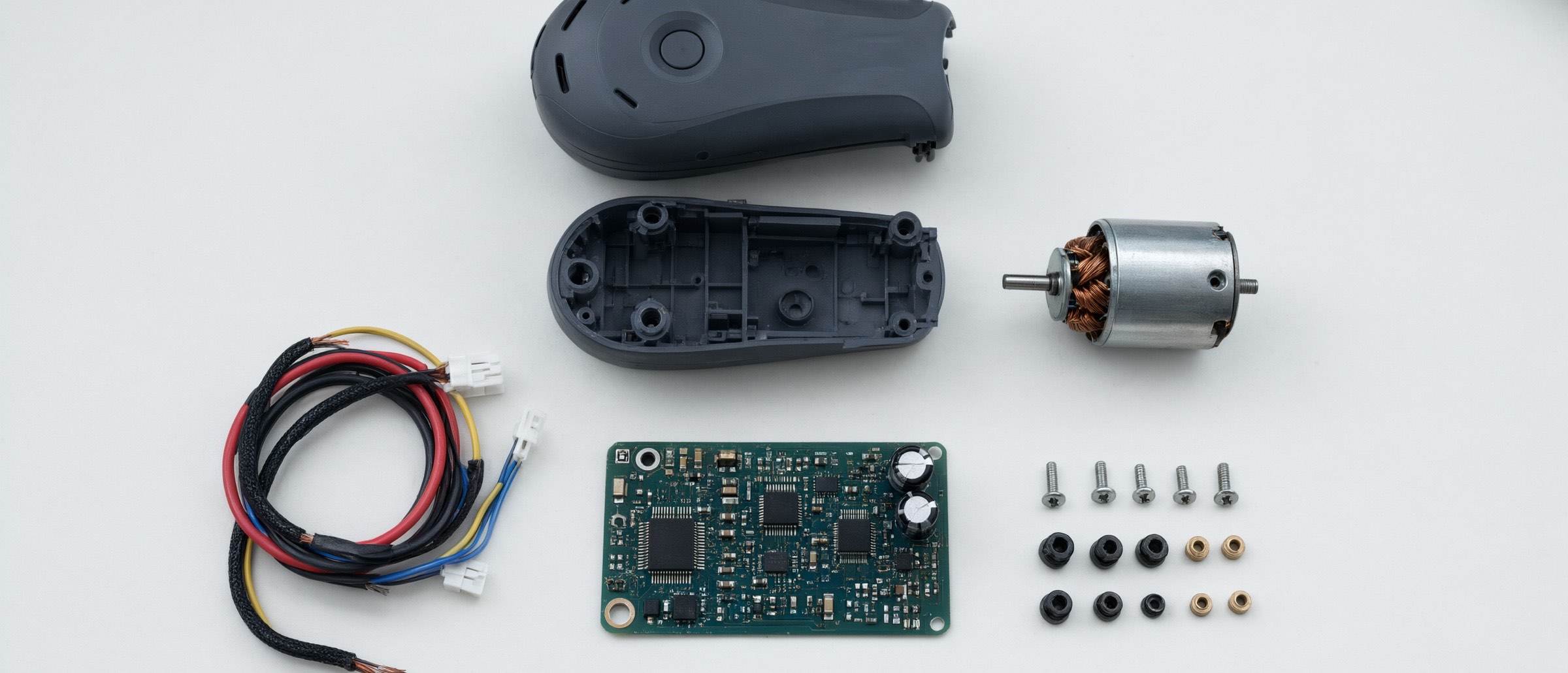
Most customs problems we're asked to clean up start the same way. A company imports finished goods for years, then moves final assembly to North America. It starts importing parts instead. And it keeps classifying them the way it always has: by looking at the purchase order and picking the code for the finished product.
Sometimes that's correct. Often it isn't. And the difference can be several percentage points of duty, a trade remedy that shouldn't apply (or one that should), and a very uncomfortable audit two years later.
Finished, unfinished, or just parts?
The Harmonized System has a rule for this, General Rule of Interpretation 2(a). Roughly: if an incomplete or unassembled article already has the essential character of the finished article, it's classified as the finished article.
So a vacuum cleaner shipped as a complete kit, unassembled in one box, is still classified as a vacuum cleaner (heading 8508). A vacuum missing only its retail box and a filter probably is too.
But a container of motors, a container of housings, and a container of wiring harnesses, arriving separately from different suppliers, usually aren't a vacuum cleaner. Each one is classified on its own:
- The motor might fall under electric motors (heading 8501).
- A wiring harness is often insulated wire with connectors (heading 8544).
- A molded housing designed only for that vacuum may be a "part" of a vacuum cleaner, under 8508.
- A generic plastic clip might be classified as an article of plastic (chapter 39), not a vacuum part at all.
Each of those can have a different duty rate and, for goods from China, may be treated differently under trade actions such as Section 301. You can't get the answer from the PO line that says "vacuum parts."
Why the PO isn't enough
Purchase orders are written for purchasing, not for customs. They say things like "Model X20 subassembly, rev C." Commercial invoices are often just as vague. The broker filing the entry has a few hours and a vague description, so they make a reasonable guess. Next shipment, a different broker might make a different guess.
That's how the same part ends up with three different codes over a year of entries. It's one of the first things auditors look for.
What we do instead: a part-level library
For every production client, we build and maintain a classification library. Each line in it is one of your part numbers, with:
- The code in each country we file in (US and, since this year, Canada).
- The reasoning, in plain language, including which rules and rulings we relied on.
- Supporting material: drawings, photos, spec sheets and material breakdowns.
- Country of origin notes, particularly for parts that pass through more than one country before they reach you.
- Any trade remedies or special programs that apply, and the date we last checked.
When a new part number shows up on a commercial invoice, the entry doesn't get filed until it's in the library. That sounds slow. In practice it adds a day, once, and saves weeks of cleanup later.
What happens when the rules change
Because every part is tied to a code, we can see immediately which of your parts a change affects. When a new tariff action is announced, our compliance team runs it against every client library the same day. Within 24 hours you get an email that says, in dollars: these 23 part numbers are affected, here's the estimated impact on your next quarter, and here are the options.
The options are sometimes real. They might include sourcing a part from a different country, changing where final assembly happens, applying for an exclusion where one exists, or using a bonded warehouse to delay duty on goods that will be re-exported. Sometimes the answer is simply "this will cost more, and here's how much."
If you're moving assembly to North America
Talk to your broker before the first parts order, not after. A few questions worth asking:
- Will the parts, imported separately, carry higher or lower total duty than the finished product did?
- Will assembly in the US or Canada change the country of origin of the finished product? (That depends on the product and on which rules apply, and the answer isn't always the one you'd hope for.)
- Which parts could be sourced from outside China without redesign?
- Is a bonded warehouse or foreign-trade zone worth it at your volumes?
We'll happily go through those with you, whether or not you ship with us.