
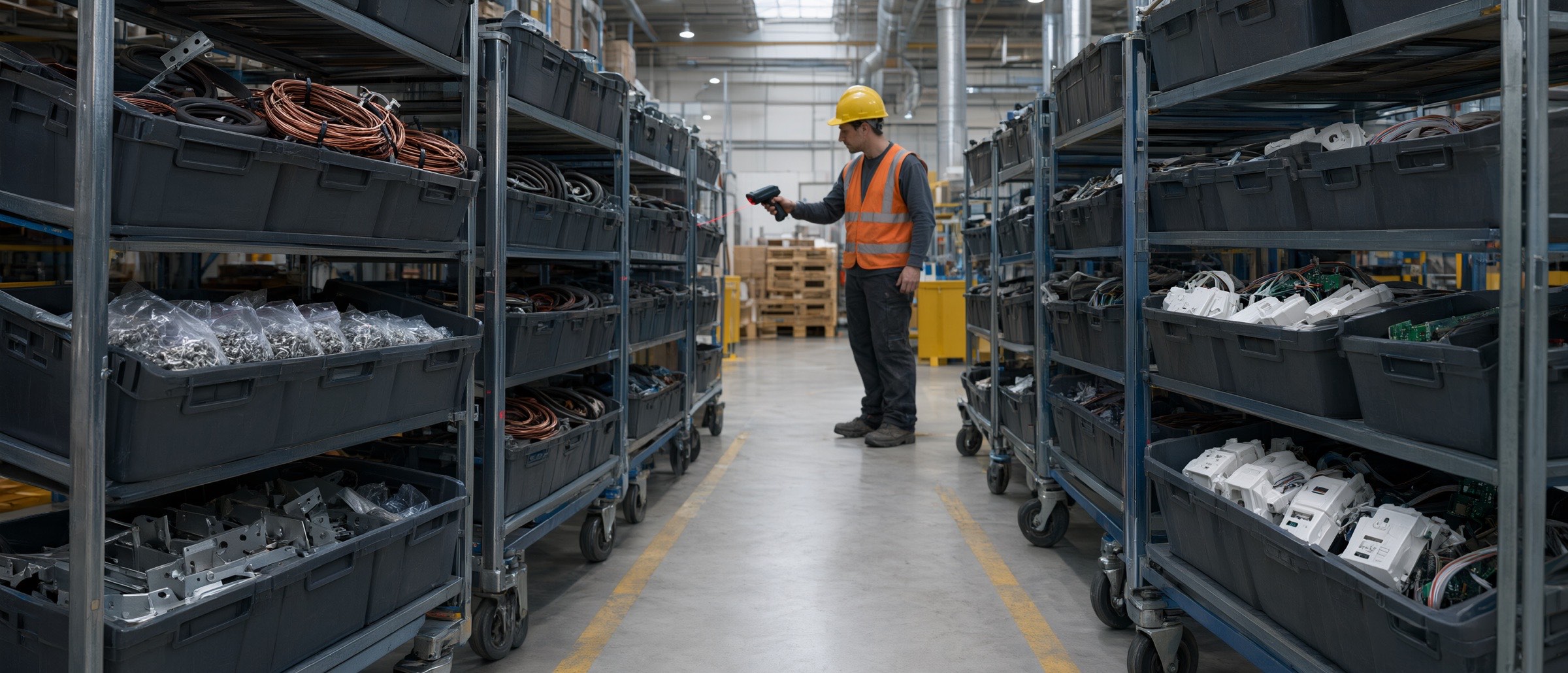
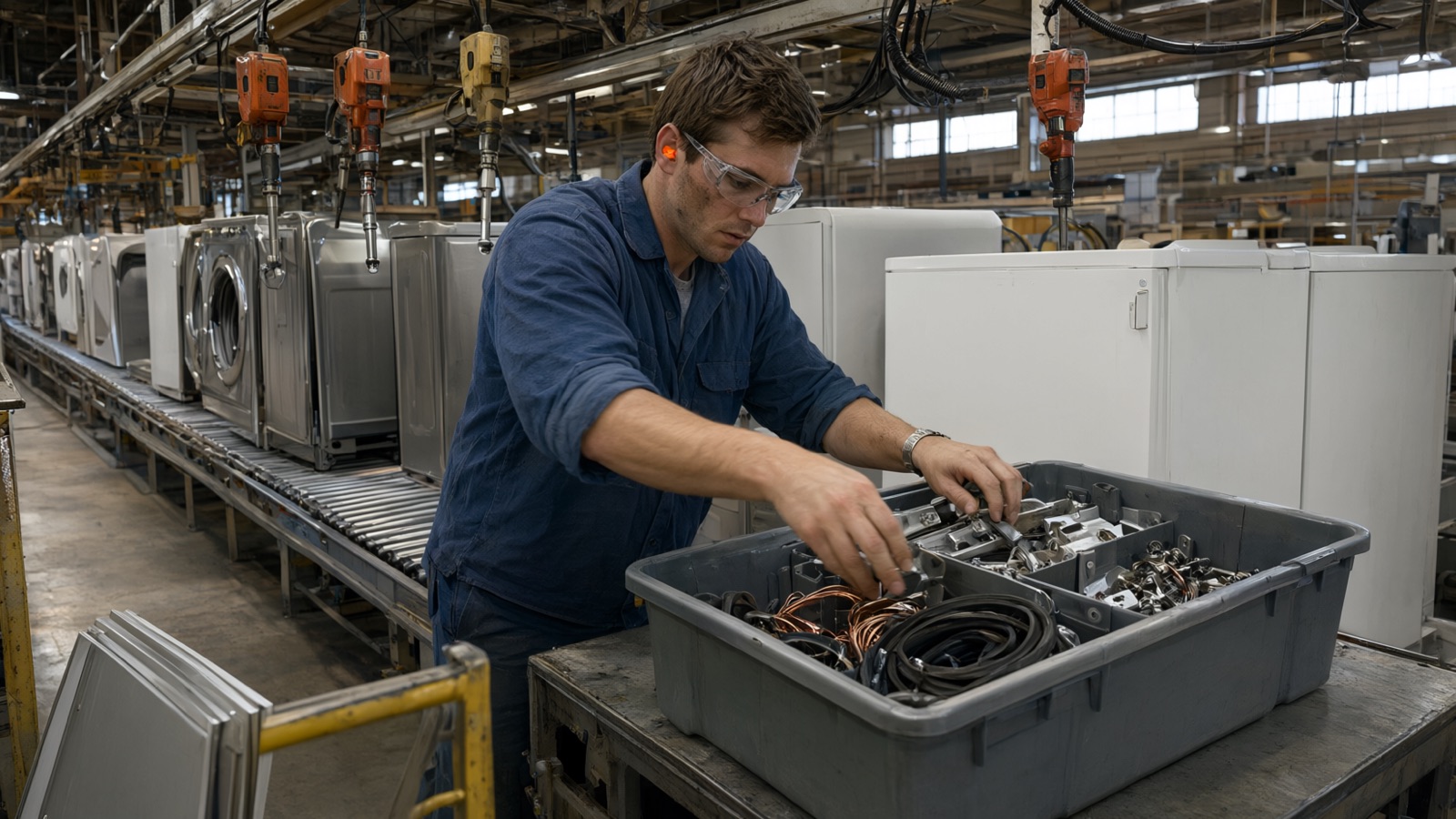
The client asked us not to name them. They assemble floor care and small kitchen appliances for several well-known brands, in a 300,000 sq ft plant in northern Ohio with two assembly lines.
The situation
When we first visited the plant in early 2025, their inbound looked like a lot of plants we see. Seven suppliers in Guangdong and Zhejiang each shipped their own parts: motors from Ningbo, PCBs from Shenzhen, molded housings from Dongguan, and so on. Some went FCL, some LCL, through two forwarders and whoever the supplier picked.
On a typical week, five to eight separate deliveries arrived at the dock. Each was broken down, counted and put away. When the line needed parts for a batch, a material handler would pull from five or six locations to build a cart.
The plant manager measured it for us: the average part spent nine days between arriving at the dock and reaching the line. And roughly twice a quarter, the line stopped because one part for a batch hadn't arrived, even though everything else had.
What we changed
1. One pickup plan for all seven suppliers
Our Shenzhen team set up a weekly milk run. Every supplier's parts for a given week's production are collected on the same two days and brought to a partner facility in Dongguan that we run kitting operations out of.
2. Kits, not cartons
Instead of shipping 1,200 motors in one pallet and 1,200 housings in another, we pack them by batch. One tote holds everything for 24 units: motors, boards, harnesses, fasteners, housings and the retail box inserts. The totes are the client's own returnable ones, shipped back empty every month.
3. Loaded in build order
Each 40' high cube is loaded so that Monday's batches come out of the door first and Friday's come out last. The container goes straight from the dock to line-side staging. No put-away.
4. Shortages caught in China
If a supplier short-ships, the kits for that batch can't be closed, and we know right away. That's usually four weeks before the line would have noticed. The client can air freight the missing parts, move the batch, or lean on the supplier while it still matters.
The results
We compared the six months before the change (Jan–Jun 2025) with six months after it was fully running (Oct 2025–Mar 2026):
| Measure | Before | After |
|---|---|---|
| Avg. time from dock to line | 9.1 days | 1.8 days |
| Inbound deliveries per week | 5–8 | 1–2 |
| Line stoppages from missing inbound parts | 4 in 6 months | 0 |
| Receiving labor (hours/week) | ~140 | ~45 |
| Freight cost per unit built | baseline | −27% |
| Parts inventory on hand | ~16 days | ~9 days |
What didn't go smoothly
It would be dishonest to say the rollout was clean. Three things went wrong, and they're worth knowing about if you're considering this.
- The first two kits were wrong. We packed to a bill of materials that was one revision out of date. We now get BOM changes pushed from the client's ERP instead of by email.
- Returnable totes went missing. About 8% of them in the first quarter. A simple barcode on every tote and a monthly count fixed most of it.
- One supplier resisted. Their own forwarder offered them a kickback we couldn't match. The client had to change the supplier's Incoterms from CIF to FCA, which took two months to negotiate.
Would this work for you?
Kitting at origin makes the most sense if you buy from three or more suppliers in the same region, run batches of a fairly stable product mix, and have a line where a missing part costs a lot. It makes less sense if your mix changes daily or if you're buying finished goods for resale.
If you're unsure, we usually start with plain consolidation (no kitting) for a quarter, measure, and decide from there.